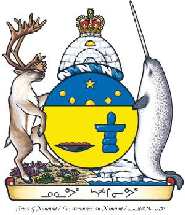
These arms were officially granted on April 1st, 1999, the day that Nunavut officially came into being. The dominant colours, blue and gold, are the ones preferred by the Nunavut Implementation Commissioners to symbolize the riches of the land, sea and sky.
In the base of the shield, the inuksuk symbolizes the stone monuments which guide the people on the land and mark sacred and other special places. The qulliq, or Inuit stone lamp, represents light and the warmth of family and the community. (The fact that it is almost impossible to recognize seriously detracts from the quality of this design.) Above, the concave arc of five gold circles refers to the life-giving properties of the sun arching above and below the horizon, as the sun does not fully set in the northern summer. The star is the Niqirtsuituq, the North Star and the traditional guide for navigation and more broadly, forever remains unchanged as the leadership of the elders in the community.
In the crest, the igloo represents the traditional life of the people and the means of survival. It also symbolizes the assembled members of the Legislature meeting together for the good of Nunavut; with the Royal Crown symbolizing public government for all the people of Nunavut and the equivalent status of Nunavut with other territories and provinces in Canadian Confederation. (Why is there a setting sun above the entrance?)
The supporters, the tuktu (caribou) and qilalugaq tugaalik (narwhal), refer to land and sea animals which are part of the rich natural heritage of Nunavut and provide sustenance for people. The compartment at the base is composed of land and sea and features three important species of Arctic wild flowers.
The motto, in Inuktitut ( don't have that font ) � NUNAVUT SANGINIVUT � means �Our land, our strength.�
Les couleurs dominantes, bleu et or, ont �t� choisies par les membres de la Commission d��tablissement du Nunavut pour symboliser les richesses de la terre, de la mer et du ciel. Sur la partie inf�rieure de l��cu, l�inuksuk sym-bolise les monuments de pierre qui guident les gens sur leur chemin et qui marquent des lieux sacr�s et d�autres sites remarquables. Le qulliq, ou lampe de pierre inuite, repr�sente la lumi�re et la chaleur associ�es � la famille et � la collectivit�.
Dans la partie sup�rieure, l�arc concave de cinq cercles dor�s �voque les propri�t�s vivifi-antes du soleil formant un arc � la fois au-dessus et au-dessous de l�horizon, un moment de l�ann�e exceptionnel au Nunavut. L��toile Niqirtsuituq, c�est-�-dire l��toile Polaire, sert traditionnellement de guide aux naviga-teurs et, de fa�on plus g�n�rale, repr�sente un rep�re fixe et immuable tout comme le conseil des sages dans la collectivit�. Pos� en timbre au-dessus de l��cu, l�iglou repr�sente la vie traditionnelle des gens et leurs moyens de survie. Il symbolise �galement les membres de l�Assembl�e l�gislative du Nunavut r�unis pour le bien-�tre du territoire. La couronne royale repr�sente, pour la population du Nunavut, le gouvernement et le statut �quivalent de ce territoire � celui des autres territoires et provinces de la Conf�d�ration canadienne.
Le tuktu (caribou) et le qilalugaq tugaalik (narval) repr�sentent tous les animaux terrestres et marins qui font partie du riche h�ritage naturel du Nunavut et qui contribuent � la subsistance de la population. La terrasse est compos�e d��l�ments de la terre et de la mer et comprend trois importantes vari�t�s de fleurs sauvages de l�Arctique.
En Inuktitut, la devise ( I don't have that font ) � NUNAVUT SANGINIVUT � signifie � Nunavut, notre force �.
Return to the Mad Alchemist's Heraldry
Return to the Mad Alchemist's Lair
© The Mad Alchemist 1999 - 2001